
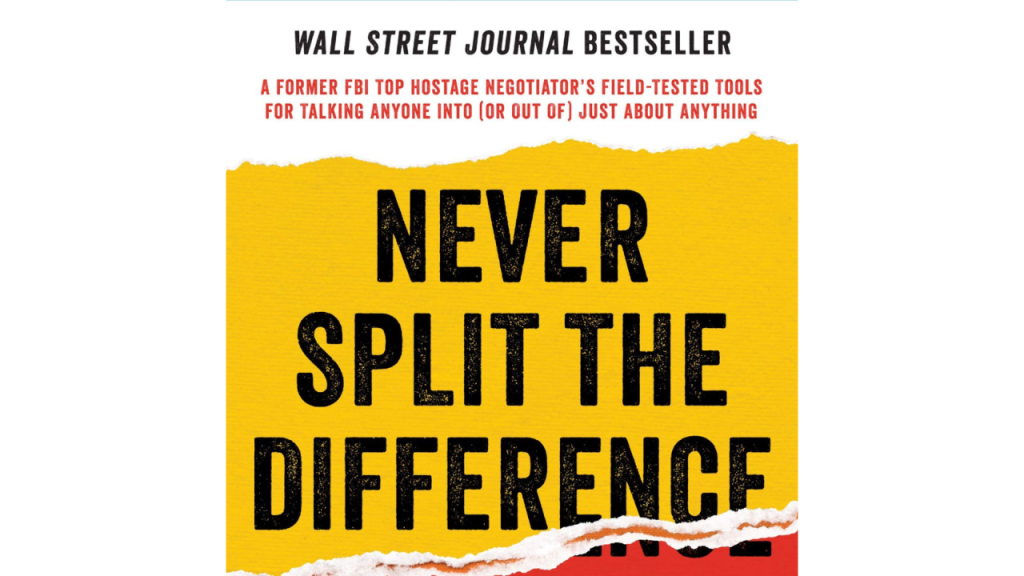
I recently made a LinkedIn post urging the leaders of Canada to read the book “Never Split the Difference” by Christopher Voss, before they go and Talk to Donald Trump about the threat of tariffs.
However, then I thought I should give them the option of Easy-Mode. Because our Politicians are just so darn efficient, they rarely waste time with doing things, and just go straight to the talking.
I also looked at the same negotiation through Dale Carnegie’s framework.
So I wanted to give a quick Easy-Mode-Cheat-Sheet for how one could use the lessons from the book “Never Split the Difference” to find win-win solutions between Canada and America:
1. Mirroring & Tactical Empathy
- How it works: Mirroring is the practice of repeating the last few words the other person says, which helps build rapport and encourages them to expand on their thoughts. Tactical empathy involves demonstrating that you understand their perspective and concerns.
- Application: Trump is likely to frame tariffs as necessary for protecting American jobs and manufacturing. Canada should mirror his language to encourage him to talk more about his objectives. Example: If Trump says, “Canada is taking advantage of the U.S. with unfair trade deals,” Canada’s response could be, “Unfair trade deals?” This invites him to elaborate without immediate confrontation. Follow up with tactical empathy: “It sounds like you’re worried that American companies are losing out in the current trade arrangement.” This makes Trump feel heard and reduces resistance to a cooperative discussion.
2. Labeling the Fear
- How it works: Labeling means acknowledging the other party’s concerns and emotions out loud. This defuses tension and makes them more likely to engage in problem-solving.
- Application: Trump’s core fear is that American jobs will be lost if foreign competitors undercut U.S. businesses. Canada should explicitly acknowledge this fear without agreeing with the premise. Example: “It seems like your priority is making sure American workers don’t suffer because of international trade policies. ”If he feels understood, he is more likely to lower his guard and listen to alternative solutions.
3. Calibrated Questions
- How it works: Instead of making direct demands or objections, calibrated questions guide the conversation by forcing the other party to think through the problem and offer solutions themselves.
- Application: Instead of outright rejecting tariffs, Canada should ask Trump questions that highlight the downsides while allowing him to remain in control. Example: “How do you see tariffs strengthening U.S.-Canada relations in the long run?” This forces him to consider the diplomatic consequences. Another effective question: “What would it take to find a solution that protects U.S. jobs while also keeping trade strong between our countries?” Since Trump values being seen as a dealmaker, these questions make him feel like he’s shaping the outcome rather than being pressured.
4. Creating the Illusion of Control
- How it works: Trump responds poorly to being pressured or told he’s wrong. Instead, by offering choices that align with Canada’s interests while making him feel in charge, we can guide him toward a favorable decision.
- Application: Canada should present potential trade solutions in a way that lets Trump think he is the one deciding. Example: “Would you prefer a deal where we both enhance job creation, or one where tariffs might create uncertainty for American businesses relying on Canadian imports? ”The first option subtly nudges him toward negotiation while making the second option seem risky. Since Trump prefers winning to losing, he is more likely to pick the path of least resistance.
5. The Ackerman Model
- How it works: The Ackerman Model is a structured way to negotiate that involves making offers in strategic increments, always leaving room for small concessions that make the other side feel like they’re winning.
- Application: Instead of outright rejecting tariffs, Canada could propose a phased-in solution that allows Trump to claim a victory while avoiding economic damage. Example: Canada might offer enhanced collaboration on certain manufacturing sectors as an alternative to tariffs, giving Trump something to point to as a win. The key is to make small concessions while positioning the final deal as the best possible outcome for both sides.
6. The Black Swan Approach
- How it works: Black Swans are unexpected pieces of information that can dramatically shift a negotiation. Identifying hidden leverage points can change Trump’s cost-benefit analysis.
- Application: Canada should highlight critical ways tariffs would backfire on U.S. interests—especially in key electoral states Trump cares about. Example: “Did you know that a tariff on Canadian steel would hurt American auto manufacturers in Michigan and Ohio, which rely on affordable Canadian materials? ”This strategy forces Trump to consider the political ramifications of his decision. If key Republican states could suffer job losses due to tariffs, he may reconsider.
Canada can steer Trump away from tariffs without direct confrontation. The key is to use calibrated questions, label his concerns, give him the illusion of control, and frame solutions in a way that allows him to claim victory.
This approach not only increases the chances of a favorable outcome but also maintains a positive long-term trade relationship.