
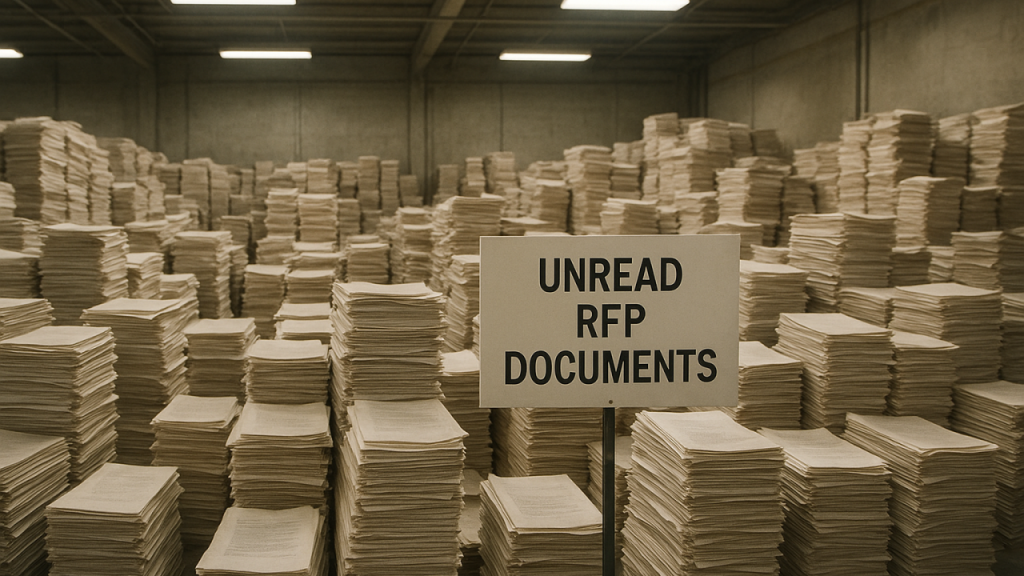
Originally posted to LinkedIn: https://www.linkedin.com/pulse/spent-20000-rfp-submission-didnt-even-read-jeremiah-vanderlaan-7m5zc
RANT TIME:
Public procurement in construction is broken.
Not because of fraud or corruption, but because of inefficiency and a process that promotes NON-VALUE waste which inflates construction costs in the industry as a whole.
I recently led an RFP submission for a client of mine.
My client is in construction, and was submitting an RFP response to a public entity in Canada.
This wasn’t a construction tender, it was an RFP for Design-Build. Meaning, it’s more of a solutions based RFP process (which I support).
The RFP documents were elaborate. They asked for a lot of specific information, and basically asked for proponents to submit full fledged designs.
The RFP response ended up being 83 pages long. Between my time and other employees of the company, we spent almost 200 hours on this submission.
The average hourly rate of the people involved is between $80-120 per hour. That’s anywhere from $16,000 to $24,000 spent on this submission.
Should a submission take this much time? No. But to effectively score all the points on their evaluation matrix, it needed this much time and attention.
Why should this matter to you? Well keep reading.
Because this is what really frustrates me….
We had an interview with the evaluation team so they could ask us some clarifying questions.
During this interview, they asked us questions that were clearly outlined in the response. I mean articulately written out and illustrated. Clear as day.
After about 40 minutes, it was apparent to me that they hadn’t read the submission document. They maybe skimmed it.
In our submission, we had given them several options to effectively solve their problem.
So I asked: “Which of the options do you think best aligns with the goals of your project”
To which they responded: “Oh, I’m not sure, I would have to read your submission”
Containing my frustration, I politely recapped the different options we suggested, and then ran out of time in the interview.
This is surprisingly very common in construction.
Companies put in thousands of dollars of work for RFP submissions to meet the insane requirements.
If they don’t, their submission is thrown out. Full stop.
Yet, on the other end, these submissions are barely read.
In fact, most of the time, the public entity already knows who they want to win the submission.
That’s why the evaluation matrices are so vague. So that they can allocate points however they want.
So what’s the big deal? Is this not just the cost of doing business?
Well yes. Construction companies need to have overhead baked in for these types of sales and marketing purposes.
But I imagine there were roughly 10 companies submitting for this RFP.
Let’s say each of the 10 companies spent $20,000 on their submission.
Doing just two RFPs per month, that’s $480,000 per company per year.
Across 10 companies? $4.8 million in annual overhead… just for submissions that most will lose.
This is VALUELESS money. There is no value to a lost RFP.
Why should you care?
Because all of that overhead has to be made up somewhere. It gets made up in other projects. Public or Private. And like I said, it’s VALUELESS. It produces no value, just flushed down the drain. It doesn’t even have meaningful intangible marketing value.
If just 10 companies represent $4.8M per year… Imagine what the Ontario Construction Industry represents. How many houses could be built with this “NON VALUE” waste?
This waste isn’t absorbed by companies quietly, it inflates the cost of every project, public or private.
That’s your tax dollars at work, producing nothing.
So what’s the solution?
It’s not Design-Bid-Build, I can tell you that. This process will just exacerbate the problem. The broader goal should be better project delivery, not simply a different procurement label.
For projects that would allow for Design-Build …
First.
Allow for proper market research prior to the RFP. In this particular example, what they were asking for … won’t work. By anyone. Some consultant told them it was feasible. It’s not.
So this project isn’t moving forward (at least how they wanted it to).
There is so much regulation about how public entities can or cannot approach the market. (I agree that regulation is required. There are bad actors who will cheat the system if they can. But it’s gotten too much).
Second.
Write simpler RFPs, and do a Stage-Gate process.
Step 1: Super Duper Simple. Base the evaluation on company experience and trust metrics. Short list a few companies.
Step 2: Interview the company and learn what their proposed solution could look like. High level conversations. Allows for some back-and-forth so that companies can really understand the goals of the project (which are rarely clearly written in the RFP docs).
Step 3: Order of Magnitude Pricing and Risk Identification. Have the shortlisted companies submit a “BALLPARK” budget number for the project. This will allow the public entity to determine if they have the budget for this project. Also have them submit a list of risks that they foresee could impact the project feasibility.
Step 4: Send to all shortlisted companies a summary of the risks identified, and a Do-Not-Exceed budget (based on feedback from step 3).
Step 5: Formal submission from shortlisted companies. Note that the RFP is to select a Design-Builder, not a design. This formal submission should not require design drawings or construction specs. That is the scope of a design-builder once selected. The submission might include concepts and massing models, but only to articulate the solution being proposed by the design builder.
Or something like that.
Does this sound like more work? Sort of. Is it? No.
It’s a stage-gateprocess, where after each step (stage), both the public entity and the proponents can decide if they want to move forward.
Do a little work: evaluate it.
Do a little more work: evaluate it
Do a little bit more: evaluate.
This will save $$$$$$$ of overhead in the construction industry.
Rant Done.
If you made it this far … you get a high five.
Some common rebuttals:
“This is just the cost of doing business in construction.”
You’re right, overhead for business development is a normal part of any industry. But that doesn’t mean we shouldn’t strive for efficiency. When the RFP process becomes so bloated that it demands full designs without compensation or proper engagement, it’s no longer just business, it’s waste. Especially when that waste ultimately inflates public project costs.
“If you don’t like it, don’t bid.”
Fair point. No one is forced to submit. But choosing not to participate doesn’t address the broader issue, whoever does submit still ends up investing tens of thousands of dollars into an inefficient and wasteful process. The system’s inefficiency affects the entire industry, inflating costs across the board, regardless of who bids. Fixing the process benefits everyone, not just those who choose to opt in or out.
“Public entities need detailed submissions to evaluate fairly.”
Agreed, to an extent. But fairness and detail don’t have to mean volume. A well-designed stage-gate process allows for fair evaluation, deeper insight, and reduced waste by focusing detailed design work only on shortlisted, qualified firms. It’s a smarter allocation of everyone’s time and money. Consider this: when public entities issue RFPs for architects, they don’t expect full building designs up front. Instead, they select based on experience, approach, and trust signals. Design-build should be treated similarly, choosing the right team first, then letting them develop the right solution.
“Some firms treat RFPs as marketing, even if they lose, it builds exposure.”
Response: True. There can be intangible benefits to submitting, like improving your process or getting on the radar of decision-makers. But that doesn’t justify inefficiency. If firms are sinking $20K+ into speculative marketing every month, something’s broken. Exposure shouldn’t come at such a steep and systemic cost, especially when the “audience” for your work is often just a handful of evaluators within one public entity. If this is treated like a marketing exercise, it’s an incredibly expensive one with minimal reach and little long-term ROI.
“The government needs rigid procurement rules to avoid favoritism or corruption.”
Absolutely. Procurement integrity matters. But rigidity without transparency leads to a different kind of unfairness, where vague criteria and unread submissions create the illusion of fairness while obscuring real decision-making. It’s especially problematic when public entities demand elaborate, resource-intensive submissions that evaluators don’t thoroughly read. That disconnect undermines trust in the process. Regulations should protect against abuse, not prevent thoughtful collaboration and common sense.