
Listen to a podcast on this topic created by NotebookLM:
Most people have had this thought at some point:
“I’m not good enough.”
At first, it can almost feel responsible. Like we’re being honest with ourselves. Like we’re seeing a weakness clearly instead of pretending it isn’t there.
And sometimes it is useful. A weakness has to be seen before it can be worked on.
But there’s a strange paradox inside that thought.
When we feel like we’re not good enough, we often don’t become more motivated. We spiral. We ruminate on the insecurity. We replay it, compare ourselves to other people, and start measuring our whole worth against one thing we don’t do well.
Slowly, the thought starts to depress the body and cloud the mind. It holds us hostage in a state of sadness, insecurity, and avoidance.
And that’s the paradox.
The belief that we’re not good enough can trap us in two directions.
It can prevent us from taking meaningful action to become better, and/or it can blind us from realizing we don’t need to be good at that thing in the first place.
Sometimes we feel inadequate, so we pull back. We pull back, so we stop growing. We stop growing, so we feel even more inadequate.
Other times, we stay fixated on a weakness that was never supposed to define us. We suffer over a gap we may not actually need to close.
Either way, the insecurity starts making decisions for us.
At that point, the trap has closed.
The Way Out Isn’t Blind Confidence
The solution isn’t to pretend we’re amazing at everything.
That isn’t confidence. It is delusion.
The solution also isn’t to shame ourselves into improvement. Shame is a poor fuel source. It might create movement for a little while, but it usually burns dirty. It leaves behind resentment, exhaustion, and self-hatred.
The better path is self-knowledge.
The ancient Delphic maxim says, “Know thyself.”
It’s simple, but it isn’t shallow.
To know yourself is to understand that you’re not meant to be everything. You’ll have strengths. You’ll have weaknesses. You’ll have natural abilities. You’ll have blind spots. You’ll be impressive in some areas and completely ordinary in others.
And that isn’t failure.
It’s part of being human.
Knowing our strengths helps, but knowing our weaknesses may do even more for our peace of mind.
Not so we can be embarrassed by them. Not so we can feel lesser because of them. But so we can stop being surprised by them. So we can stop treating every weakness like a personal crisis. So we can stop confusing a lack of ability in one area with a lack of value as a person.
Our strengths also might not match the strengths of the people around us.
That can be uncomfortable.
Maybe your social group values humour, but you’re more thoughtful than funny. Maybe they value athleticism, but you’re more analytical. Maybe they value charisma, but you’re more disciplined. Maybe they’re strong in areas where you feel weak.
That doesn’t mean you’re behind.
It means you’re different.
We’re not meant to be good at everything. And we’re not meant to only surround ourselves with people who have the exact same strengths we do.
In fact, that would be a weaker way to live.
A healthy group of people should have different strengths. One person sees what another misses. One person carries what another can’t. One person leads in one area, and someone else leads in another.
So the goal isn’t to be strong in every direction.
The goal is to know where you’re strong, know where you’re weak, and stop letting every comparison become a verdict on your worth.
We can’t be everything. We can’t master everything. We can’t be the best at everything.
Once we accept that, we can stop being depressed by every area where we’re not naturally strong.
Ask a Better Question
When insecurity shows up, the question shouldn’t be:
“Am I good enough?”
That question is too vague. Too emotional. Too dangerous.
Good enough for what? Good enough compared to who? Good enough by what standard?
It’s a question that often leads nowhere useful.
A better question is this:
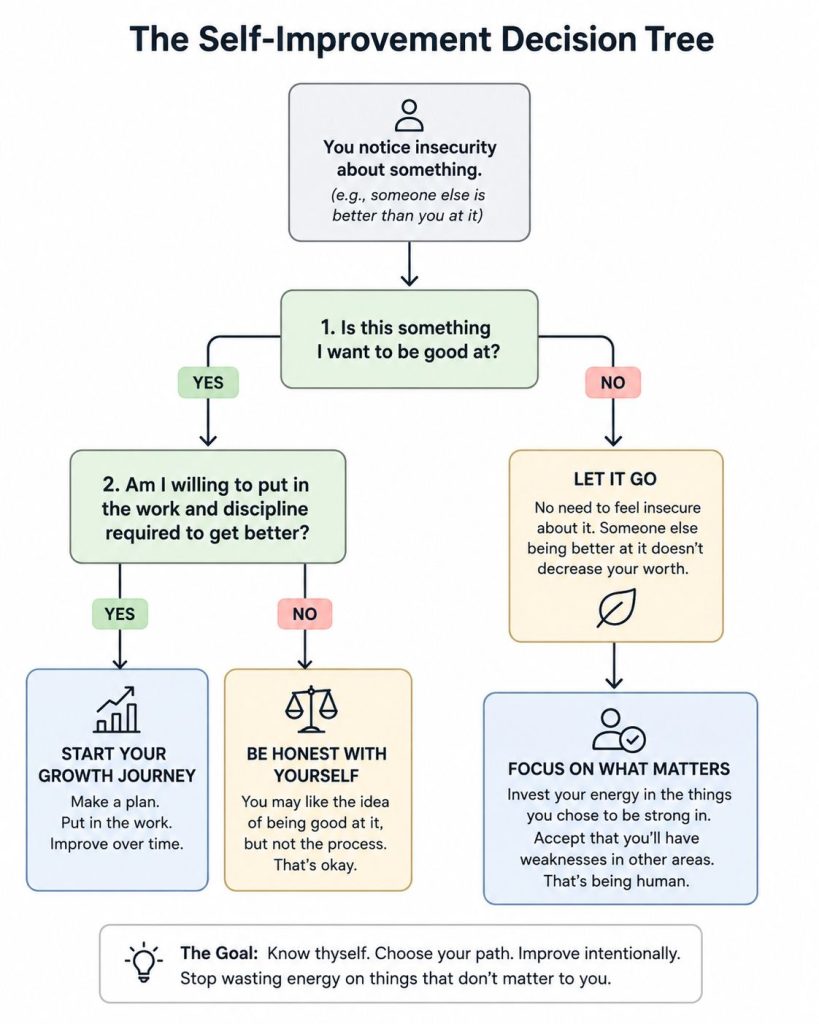
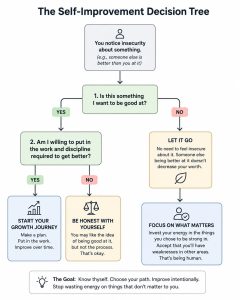
“Is this something I actually want to be good at?”
That question forces the issue into something more concrete.
Because sometimes the answer is yes.
Yes, I want to be a better communicator.
Yes, I want to be a better leader.
Yes, I want to be more disciplined.
Yes, I want to be healthier.
Yes, I want to become more skilled in this area.
If the answer is yes, then the next question is:
“Am I willing to put in the work required to become better?”
Because wanting the outcome isn’t the same as wanting the process.
A lot of people want to be in shape. Fewer people want to train consistently.
A lot of people want to be confident speakers. Fewer people want to practice, fail, improve, and try again.
A lot of people want to be successful. Fewer people want the repetition, sacrifice, boredom, and discipline that success often requires.
So if the answer is yes, and you’re willing to do the work, then the path is simple.
Start.
Don’t spiral. Don’t sit in shame. Don’t turn the weakness into an identity.
Turn it into a project.
Make a plan. Practice. Get feedback. Build the skill. Grow.
But if the answer is no, that also tells you something.
If you’re not willing to pay the price required to become better at something, then maybe you don’t truly want it. Maybe you only like the idea of being good at it. Maybe you admire the result, but don’t want the process.
And that’s okay.
You’re allowed to choose.
Not Every Weakness Is a Problem
This is where a lot of unnecessary suffering disappears.
If you ask, “Is this something I actually want to be good at?” and the answer is no, then you can let it go.
You don’t need to feel insecure every time someone else is better than you at something you don’t actually care to master.
Someone else can be better at golf.
Someone else can be better at fashion.
Someone else can be better at dancing.
Someone else can be better at telling jokes.
Someone else can be better at fixing cars, cooking meals, playing music, networking, or public speaking.
That doesn’t mean you’re less valuable.
It means they built strength somewhere you didn’t.
And chances are, you built strength somewhere else.
Not every weakness is a crisis. Not every gap is a personal failure. Not every comparison deserves your attention.
Some weaknesses are simply the result of choosing to become strong in other areas.
There’s no shame in that.
It gives you clarity.
Define What You Want to Be Strong In
A person who doesn’t know themselves is vulnerable to every comparison.
They see someone successful and feel inferior. They see someone talented and feel inadequate. They see someone praised and feel invisible.
But a person who knows themselves can respond differently.
They can say:
“That’s impressive, but it’s not my path.”
Or:
“That’s a weakness I need to work on.”
Both responses are healthier because both are grounded in truth.
The goal isn’t to avoid all insecurity. The goal is to interpret insecurity properly.
Sometimes insecurity is a signal that we’re neglecting something we’ve chosen to value.
Other times, insecurity is just noise created by comparison.
Self-knowledge helps us tell the difference.
When we define what we actually want to be strong in, we also give ourselves permission to be weak in other areas.
That permission frees us from the impossible burden of trying to become everything.
Getting Out of the Paradox
The “I’m not good enough” paradox is that the feeling of inadequacy often consumes the energy required to improve.
The way out isn’t pretending we have no weaknesses.
The way out is knowing which weaknesses deserve our work.
If a weakness matters, work on it.
If it doesn’t, release it.
Know yourself. Define your strengths. Accept your limits. Choose your areas of growth.
Then stop wasting emotional energy on the things you haven’t chosen to become.
You’re not here to be good at everything.
You’re here to become who you’re meant to become.