
Listen to a podcast on this topic created with NotebookLM:
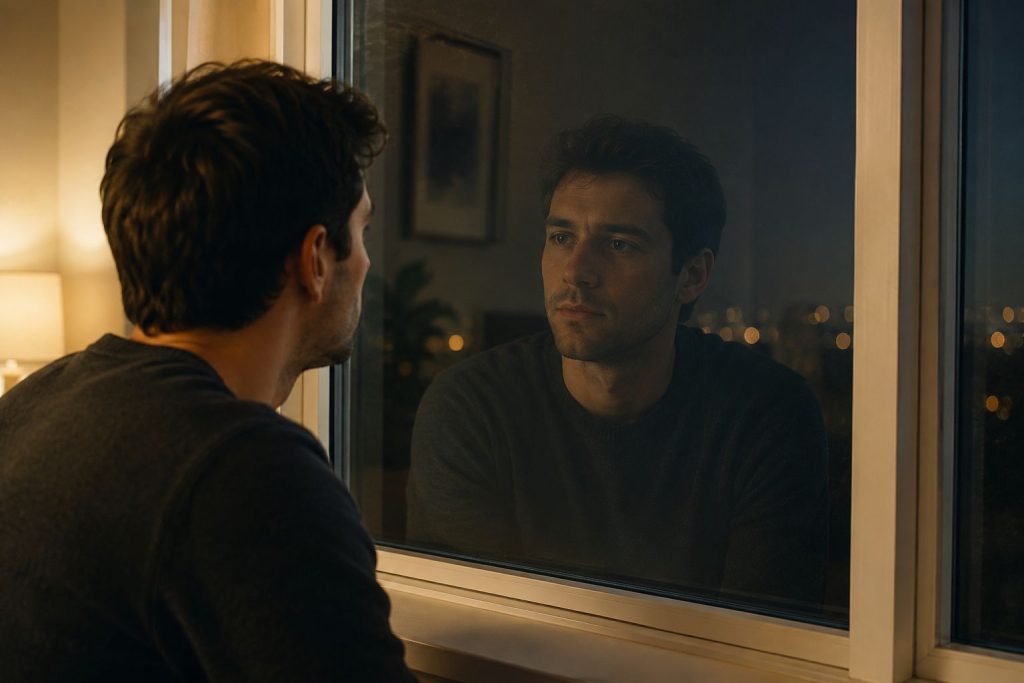
Have you ever stood inside your house at night with the lights on and tried to look out the window?
You can’t really see much.
The glass turns dark. The outside world disappears. You might see a few vague shapes, maybe a porch light across the street, but mostly what you see is your own reflection staring back at you.
But if you turn off the lights in your house, the view through the window changes.
Now you can see outside. You can see the houses across the street. You can see trees, cars, lights, movement, and detail. The world was there the whole time, but the brightness inside your own house was preventing you from seeing it clearly.
I think our opinions and biases work the same way.
When the light of our own opinion is too bright, we often stop being able to see the outside world. In many cases, we just end up seeing our own reflection.
And maybe the most dangerous part is that we don’t always know it’s happening.
Bias Can Make the Window Look Like a Mirror
When the light is on inside the house, the window doesn’t stop being a window. It still looks like a window. You’re still facing outward. You’re still standing in the right place.
But functionally, it has become a mirror. And the brighter the lights inside, the more reflective the window becomes.
Bias can work the same way.
You might believe you’re looking at a political issue, a business problem, a religious question, a personal conflict, or some cultural debate. You might believe you’re carefully observing the facts.
But if your own bias is glowing too brightly in the room, you might just be seeing yourself.
Your assumptions.
Your past experiences.
Your fears.
Your frustrations.
Your social group.
Your need to be right.
Your desire for the world to make sense in the way you already understand it.
This doesn’t mean your opinion is automatically wrong. That’s not the point. Sometimes your opinion might be well-earned, carefully formed, and mostly correct.
But even a good opinion can become too bright.
Even a mostly correct view can blind you to details.
Even a reasonable belief can start acting like a light inside the house, reflecting your own face back at you when you’re trying to see what’s outside.
Keeping an Open Mind Requires More Than Saying You Have One
Most people like the idea of having an open mind.
It sounds good. It sounds mature. It sounds like something reasonable people should say about themselves.
But keeping an open mind is not just a personality trait. It is a practice.
It requires noticing when your own bias is taking over the room.
And that’s harder than it sounds, because bias doesn’t usually feel like bias from the inside. It feels like clarity. It feels like common sense. It feels like, “I’m just seeing things the way they are.”
Bias gets so much power because it doesn’t feel like distortion.
It doesn’t announce itself.
It doesn’t walk into your mind and say, “Just so you know, I’m about to distort your view of reality.”
It simply turns the light on.
Then the window becomes a mirror.
And because you can still see something, you assume you’re seeing clearly.
Turn Off Your Opinion
Now, to be fair, I don’t think we can literally shut off our opinions or biases completely.
We aren’t neutral machines. We all have backgrounds, instincts, preferences, memories, loyalties, and emotional reactions. Those things don’t vanish because we decide to be objective for five minutes.
However, I think we should all strive to learn how to “turn off” our opinions from time to time.
To turn off your opinion doesn’t mean you permanently abandon it. It doesn’t mean you become passive, uncertain, or unwilling to make judgments.
It means you practice looking at something as if your opinion was not already in charge.
It means you pause your conclusion long enough to observe. You give reality a chance to show itself before your existing belief rushes in and explains everything away.
Then, after you’ve looked clearly, you can turn the light back on.
You can bring your opinion back into the room.
But now your opinion has to deal with what you actually saw.
You Might Not Even Know There Is a World Outside
When the lights are on inside the house, you aren’t simply seeing the outside poorly. In some cases, you may not even realize how much outside there is to see.
Strong bias does more than distort the world.
It can shrink the world.
It can make your current view feel like the whole picture. It can make other perspectives seem ridiculous before you’ve even understood them. It can make you dismiss people before you’ve actually heard them.
And once that happens, your mind is not really open anymore.
It might feel open because you’re still thinking, debating, explaining, and defending your position. But an active mind is not always an open mind.
Sometimes an active mind is just a well-lit room full of mirrors.
We All Have Our Own Lights On
There is another side to this.
Once I understand that my own opinions and biases can create mirrors, I should be slower to condemn other people when they can’t see what I see.
Because they have lights on too.
Their own experiences, fears, loyalties, wounds, assumptions, and social groups may be reflecting back at them just as strongly as mine reflect back at me.
Hanlon’s Razor helps here. It is often summarized as: “do not attribute to malice what can be adequately explained by ignorance.”
I think that idea applies here.
When someone disagrees with me, misunderstands something, reacts poorly, or seems unable to see what appears obvious to me, it’s tempting to assume bad intent. It’s tempting to think they’re dishonest, stubborn, manipulative, or malicious.
And sometimes people are acting in bad faith. I don’t want to be naive about that.
But often, something else is happening.
Their lights are on.
Their bias may be turning the window into a mirror. Their past experiences may be shaping what they can see. Their fear, pride, pain, loyalty, or social environment may be limiting the view available to them.
That doesn’t mean every opinion is equally valid.
It doesn’t mean bad ideas should be ignored.
It doesn’t mean truth no longer matters.
But it should create some grace.
Because if I know how hard it is for me to see past my own bias, I should understand that it might be hard for others too.
Maybe the person I disagree with is not simply being difficult.
Maybe they’re looking through a window that has become a mirror.
Maybe they genuinely cannot see what seems obvious to me.
And of course, the uncomfortable part is that the same thing may be true in reverse.
They may see something I cannot see yet.
Humility becomes the safeguard against mistaking a partial view for the whole picture.
Not fake humility. Not the kind where we pretend all ideas are equal and no one can know anything.
I mean practical humility.
The kind that says, “I may be seeing part of this clearly, but I should be careful before assuming I see the whole thing.”
The Discipline of Looking First
One of the most useful habits a person can develop is the ability to ask:
“What would I see here if I didn’t already have an opinion?”
That question doesn’t require you to become perfectly unbiased. It just creates a little bit of space.
And sometimes, that space is enough.
It allows you to notice the detail you were missing. It allows you to hear the argument you were dismissing. It allows you to understand why someone else might see the same situation differently.
That does not mean we need to believe that they’re right. Understanding why someone believes something is not the same as agreeing with them.
We often avoid understanding opposing views because we think understanding is a form of surrender. It is not.
In reality, understanding gives you more clarity, not less.
If your opinion cannot survive a few minutes with the lights off, it may not be as strong as you thought.
Turn the Light Back On Carefully
The point of this analogy is not to live in darkness.
You don’t turn off the lights in your house forever.
You simply realize where the light switch is in the room, and you turn the lights off when the light inside is preventing you from seeing outside.
Then, once you’ve seen what is actually there, you can turn the lights back on and think about it.
That is probably the healthiest relationship with opinion.
Have opinions.
Build them carefully.
Use them.
Test them.
But every so often, turn them off long enough to look out the window.
Because sometimes the thing blocking your view is not the darkness outside.
Sometimes it is the brightness inside.