
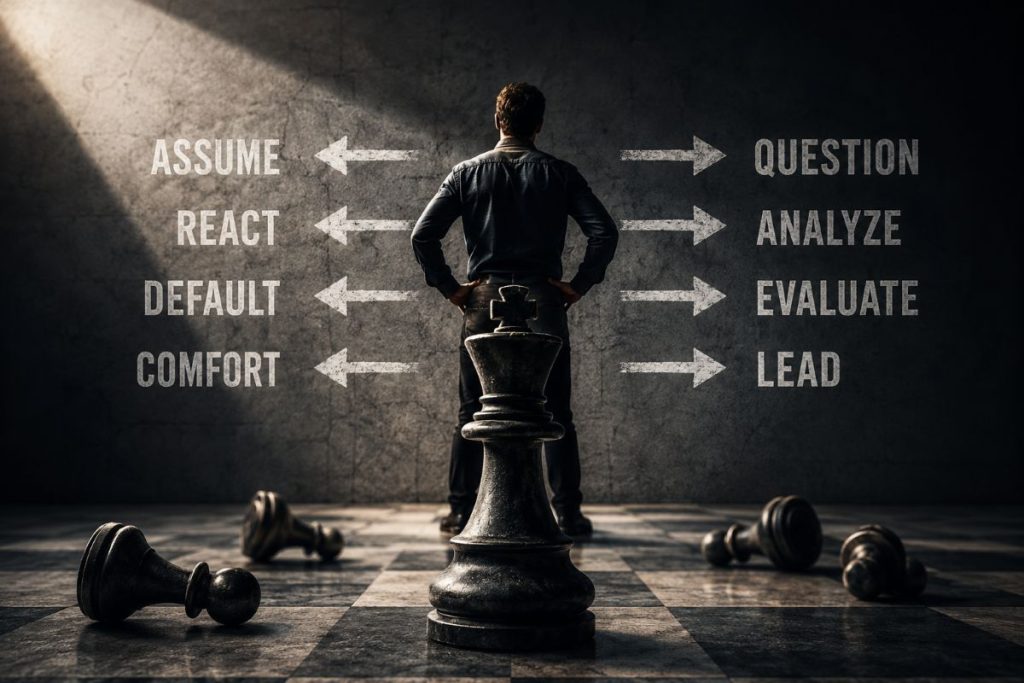
As humans, we don’t always know why we make the decisions we make.
We don’t always know why we have the opinions and perspectives we hold.
We like to believe our opinions are carefully formed. We like to believe our decisions are logical, deliberate, and thoughtful. Sometimes they are. But a lot of the time, if we’re being honest, we’re operating from mental shortcuts.
We develop assumptions, reactions, opinions, and little internal frameworks that become part of how we see the world.
“That customer is being unreasonable.”
“We don’t have time to do it properly.”
“That person always does this.”
“This is how we’ve always done it.”
“If I ask a question, I’ll look weak.”
Sometimes those instincts are useful. They help us move quickly. They reduce the amount of mental energy we need to spend on every little decision. If we had to deeply analyze every thought we had in a day, most of us would be completely useless by lunch.
So the problem isn’t that we have shortcuts.
The problem is that we often forget they are shortcuts.
Over time, they start to feel like truth. They become knee jerk opinions, knee jerk reactions, and knee jerk decisions. We stop asking where they came from. We stop asking whether they’re still useful. We stop asking whether they’re serving the project, the client, the team, or just protecting our own comfort.
And this is where leadership becomes difficult.
Because as a leader, part of your job is to challenge thinking. Your own thinking first, ideally, which is annoying and inconvenient. But also the thinking of your team.
Not in a toxic way. Not in a “let me prove I’m smarter than you” kind of way. Not in a “gotcha” kind of way.
More in a “let’s think deeper here” kind of way.
That line is thin. Cross it, and the team hears accusation instead of curiosity.
The same question can feel like coaching or criticism depending on the culture around it. If the culture is blame, questions feel like attacks. If the culture is learning, questions feel like training. And trust is an outcome of how an organization behaves, not simply what it says it values.
The Goal Is Not Perfect Decisions
One of the mistakes leaders make is assuming the standard should be “make the right decision.”
That sounds reasonable at first. Obviously, we want good decisions. Obviously, we want the right outcome. Nobody is sitting around hoping for a worse result, unless they are, in which case you may have a different problem.
But in the real world, the right decision isn’t always obvious when the decision has to be made.
The information is incomplete. Time is limited. Resources are stretched. People are under pressure. There are tradeoffs everywhere. You may have a demanding client, a frustrated team member, a delayed supplier, a budget issue, and three other things happening at the same time.
Then, after everything unfolds, you get the full picture.
Hindsight makes the answer look cleaner than it was.
A toxic leader judges a decision using information that wasn’t available when the decision was made. They get to watch the whole movie, then criticize the actor for not knowing the ending.
The toxic leader gets full hindsight and then says, “Of course that would be the outcome.”
But that isn’t fair.
You have to assess the decision-making using the same information that was available when the decision was made. Once you know the outcome, you’re already biased by it.
That’s not leadership. That’s convenient blame.
A good leader looks at the decision in context.
- What did you know at the time?
- What options did you consider?
- What else was going on?
- What constraints were you under?
- What resources were actually available?
- What were you trying to protect or prioritize?
That doesn’t mean every decision gets excused. Some decisions are careless. Some are selfish. Some are lazy. Some are made because someone didn’t want to think, ask, document, communicate, or take ownership.
But there is a major difference between a bad outcome and a bad decision process.
A thoughtful decision can still lead to a poor result.
A lazy decision can occasionally get lucky.
The outcome matters, of course. But if you only judge the outcome, you will eventually train people to avoid responsibility instead of improving their thinking.
Lazy Decisions Versus Thoughtful Decisions
A lazy decision has no real reasoning behind it.
It isn’t always dramatic. Sometimes it sounds very normal.
“I just figured…”
“I assumed…”
“That’s what we usually do…”
“I didn’t think it mattered…”
“I thought someone else was handling it…”
Those might be honest answers, but they’re not always evidence of good thinking.
A more thoughtful decision has a visible thought process behind it. It doesn’t need to be perfect. It doesn’t need to be a twenty-page report. But there should be some indication that the person paused long enough to consider what they were doing.
At minimum, a thoughtful decision usually includes a few things:
- What are we trying to accomplish?
- What options do we have?
- What seems like the best option given what we know right now?
- What are the risks?
- Who else is affected?
- What would change my mind?
A person who can’t tell you what would change their mind may not be thinking clearly. They may just be defending a position.
And again, this applies to leaders too.
Actually, it applies to leaders more.
Because leaders are often the most dangerous when they assume their instincts are automatically wisdom. Sometimes they are. Sometimes they’re just expertise creating blind spots—old shortcuts wearing a nicer jacket.
Decisions Without Data
Another sign of lazy decision-making is ignoring information that’s already available.
Not every poor decision comes from a lack of data. Sometimes the data exists. Sometimes it’s sitting in your CRM, job management software, accounting system, project reports, customer feedback, timesheets, or historical records.
But looking at it would require effort.
So instead, the decision gets made on gut feel.
Now, to be clear, gut feel is useful.
If a decision needs to be made immediately and there’s no time to gather information, trust your experience.
If there genuinely is no information available, trust your judgment.
If you’re dealing with a novel situation where there’s no meaningful data to analyze, then instinct may be the best tool you have.
The problem is when people use gut feel as a substitute for information rather than a complement to it.
A thoughtful decision-maker asks:
“What information do we already have?”
“What can we learn from previous situations?”
“What evidence supports this decision?”
A lazy decision-maker skips those questions because they take work.
When recurring decisions keep getting made from instinct because no information exists, the company should notice the pattern.
- Why don’t we have data?
- How could we collect it?
- How could we make future decisions easier?
Good leaders don’t just make decisions. They improve the quality of future decisions.
If a recurring decision is being made based on guesswork, then there’s probably an opportunity to start collecting information. Maybe that means tracking job durations. Maybe it means recording customer complaints. Maybe it means measuring response times, profitability, rework, delays, or resource usage.
Ideally, this information is collected automatically wherever possible.
The goal isn’t to create more admin work. The goal is to create better visibility.
Over time, you move from making decisions based entirely on instinct to making decisions informed by evidence.
And interestingly, the best decision-makers often use both.
They look at the data.
They understand the context.
Then they apply judgment.
Data without judgment can be misleading.
Judgment without data can be reckless.
The strongest decisions usually combine both.
The Leader’s Job Is to Make Thinking Visible
A strong team is not a team where everyone waits for the boss to give the answer.
That may feel efficient in the short term, especially if the leader is competent. The team asks. The leader answers. The issue moves forward.
But over time, this creates a dependency loop.
The team learns that hard questions go up the chain. The leader becomes the default decision maker. Every unclear situation turns into, “Boss, what do I do here?”
This is what many leaders describe as “putting out fires.”
But sometimes the issue isn’t that there are too many fires. Sometimes the issue is that the leader has accidentally trained the team to bring them every match, spark, and slightly warm object.
That’s exhausting.
And to be fair, the team may not be doing this because they’re lazy. They may be doing it because the culture has taught them that making the wrong decision is dangerous. They may have learned that initiative gets punished if it doesn’t work out perfectly. They may not know where the SOP is. There may not be an SOP. They may not know what the priorities are.
So if the leader wants better decision-making, the answer is not simply, “Use your brain.”
That’s not a system. That’s frustration with a job title.
The better approach is to slowly build a culture where people are expected to bring their thinking, not just their problem.
“What Do You Think We Should Do?”
A leader can change a lot of conversations with one question:
“What do you think we should do?”
Or:
“What do you think the best approach is?”
Or:
“If I wasn’t here, what decision would you make?”
Or:
“Make the call, and walk me through your reasoning.”
These questions return the decision back to the person close to the problem.
That doesn’t mean the leader abandons them. It doesn’t mean the leader refuses to help. It means the leader refuses to become the answer machine before the other person has had to think.
The point isn’t to trap the person.
The point is to train judgment.
When someone comes to you with a problem, and you immediately give them the answer, you may solve the issue in front of you. But you may also reinforce the habit that they should come to you before thinking deeply.
When you ask what they think should happen, you’re saying, “I’m willing to help, but I need to see your thinking first.”
That changes the conversation.
It also filters out lazy questions. Over time, people learn not to bring a problem without at least bringing a proposed path forward.
The Conversation Has to Be Safe Enough to Work
This only works if people don’t get defensive the moment their thinking is questioned.
And people usually get defensive for a reason.
They get defensive because, historically, questions have meant punishment. They’ve learned that being asked “why did you do that?” is not a request for understanding. It is the opening statement in a trial.
So leaders need to be careful here.
If you ask “What were you thinking?” with the wrong tone, you’re not building a decision culture. You’re making people regret speaking.
The better approach is curiosity.
“Help me understand your reasoning.”
“What other options did you consider?”
“What risk were you trying to manage?”
“Who is affected by this decision?”
“Is this best for the project, the client, and the team?”
“Do we have an SOP for this?”
“Do we need to create or update one?”
“That’s interesting. I didn’t think of it like that.”
That last sentence does something useful. It tells the person that their thinking is not just being inspected. It’s being taken seriously.
A leader doesn’t need to agree with every recommendation. But if the team believes the leader is genuinely trying to understand, the conversation changes. People become more willing to show their thought process before it’s fully polished.
That’s where growth happens.
The Leader Has to Control the Emotional Weather
A lot of this comes down to whether the leader can control their emotions.
If your team knows that your stress turns into blame, they will stop thinking out loud. They’ll start hiding uncertainty. They’ll escalate every decision to protect themselves. Or worse, they’ll make decisions quietly and hope nobody notices.
None of that creates better thinking.
If your team knows that your stress still comes with calm curiosity, they’ll bring you better information. They’ll be more honest about what they were unsure about. They’ll be more willing to say, “Here’s what I thought, here’s what I missed, and here’s what I’d do differently next time.”
That creates a healthier culture.
It does not mean there are no standards.
Actually, it means the standards become clearer.
The standard is not “never be wrong.”
The standard is “think well with what you knew at the time.”
That standard is both fair and demanding.
It’s fair because it doesn’t punish people for information they didn’t have.
It’s demanding because it doesn’t excuse careless thinking.
A Simple Decision Standard
I do think there’s value in making this practical.
Not every decision needs a form. I would not recommend turning every small choice into a bureaucratic ceremony. Nobody needs a decision log to choose where to put the extra box of screws.
But for decisions that are ambiguous, risky, expensive, client-facing, or likely to affect other people, a simple decision standard can be useful.
Before escalating a question, a team member should be able to answer:
- What’s the goal here?
- What options did I consider?
- What information or data did I review?
- What do I recommend and why?
- What’s the risk, and how can we reduce it?
- What would change my mind?
If someone can answer those questions, they’re thinking.
They may still be wrong, but they’re not just reacting.
And if they can’t answer those questions, that’s not necessarily a character flaw. It may just mean they need coaching, clarity, or a better system.
You’re not trying to catch people being stupid. You’re trying to make thinking visible so it can improve.
The Decision Integrity Log
One practical way to build this culture is through something I’d call a Decision Integrity Log.
The name itself sets the boundary.
This is not a performance evaluation tool. It’s not a disciplinary record. It’s not a place to create evidence against people later. If that’s how it gets used, the whole thing becomes toxic almost immediately.
The purpose is different.
A Decision Integrity Log is a place where someone can record an ambiguous decision they made, why it was ambiguous, what information they had available at the time, and why they believed their decision was the best path forward.
That might include a decision where they had to veer from an SOP, SOD, policy, or system because the situation didn’t fit cleanly into the existing process. It might include a decision where there were two reasonable options and neither one was perfect. It might include a decision where they had to act before they had all the information they wanted.
The point isn’t to create paperwork.
The point is to make decision-making visible.
In a healthy company, this can almost become a journal for employees. Not a diary of feelings necessarily, but a practical record of judgment.
Here is what I saw.
Here is what I knew.
Here is what I believed was best.
Here is why I made the call.
A record like this starts to change behavior.
First, it encourages people to make decisions instead of waiting for permission on every unclear issue. If the culture is healthy, the message becomes: make the decision, but be prepared to explain your thinking.
Second, it helps the company improve its systems. If people keep logging decisions where the SOP, SOD, or policy did not fit reality, then maybe the problem is not the employee. Maybe the system needs to be updated.
Third, it brings critical thinking to the front end of decision-making, not only to the post-mortem after something goes wrong.
At first glance, this might sound like a toxic culture.
It could be, if handled poorly.
If every decision log becomes a courtroom exhibit, people will stop using it honestly. They’ll write defensively. They’ll hide uncertainty. They’ll make the log sound more polished than the actual decision-making was. At that point, you haven’t built a culture of integrity. You’ve built a culture of corporate self-protection, which is not the same thing.
But if handled properly, the Decision Integrity Log does the opposite.
It builds a curiosity culture.
It says, “We care about why decisions were made. We care about whether people were thinking clearly. We care about whether the decision served the project, the client, the team, and the business, not just the individual.”
That is where this ties into integrity.
Not integrity in the shallow sense of “did you follow the rule perfectly?”
Integrity in the deeper sense of, “Were you honestly trying to make the best overall decision with the information available to you?”
Without that deeper standard, people can hide behind process while making decisions that protect themselves more than the project, the client, or the team.
Sometimes the best decision for the project is not the easiest decision for the person making it. Sometimes the best decision for the client creates more work for the team. Sometimes the best decision for the team requires an uncomfortable conversation with the client.
These are not always clean decisions.
So the habit I would want to build is a simple mental map:
- This is the information I have available to me right now.
- It’s my opinion that this is the best approach for the project, the team, and the client.
- This is how the decision affects me personally.
- This is how it affects the team.
- This is how it affects the project or client.
- If everything goes wrong, I believe this decision is still defensible based on what I knew at the time.
The last point doesn’t mean, “I know this will work.”
It means, “Even if this doesn’t work, I can honestly explain why this was a reasonable decision when I made it.”
That standard encourages a bias toward action without encouraging recklessness. It tells people not to freeze just because a decision is ambiguous. But it also tells them not to act carelessly and hope nobody asks questions later.
Make the decision.
Think it through.
Write down the reasoning when the situation deserves it.
Be willing to revisit it later.
That’s not bureaucracy. That’s decision integrity.
Long term, I could also see this being supported by an AI assistant trained on the company’s own Company Brain. Not as the authority. That part needs to stay clear. The AI should not become the boss, the lawyer, or the final answer.
But it could become a guide.
It could help someone ask, “Is there an existing SOP for this? Have we made a similar decision before? What risks should I consider? What would be a reasonable way to document my thinking?”
Used properly, that could strengthen the culture even further.
Not by replacing human judgment.
By helping people practice it.
The Value of Looking Back Properly
There is also value in reviewing tough decisions after the fact, but only if it’s done properly.
A decision review should not be a blame session dressed up as learning.
The useful questions are:
- What decision was made?
- What information was available at the time?
- What options were considered?
- Why did that option seem best?
- What happened?
- What did we learn?
- Does an SOP, SOD, policy, system, or expectation need to be updated?
The review changes as soon as you ask, “What information was available at the time?”
Without that question, the review becomes unfair very quickly.
If the thinking was solid but the outcome was poor, that’s a learning opportunity.
If the thinking was sloppy, that’s a coaching opportunity.
If the system was unclear, that’s a leadership opportunity.
But if every bad outcome becomes punishment, the culture will adapt. People will stop taking initiative. They’ll stop owning decisions. They’ll learn to protect themselves instead of improving the work.
And honestly, you can’t blame them.
People behave according to the environment they’re in.
What This Builds Over Time
The goal is not to have a team that makes perfect decisions.
That team doesn’t exist.
The goal is to have a team that thinks clearly, communicates honestly, learns quickly, and becomes less dependent on the leader over time.
That is a very different kind of leadership.
It’s slower at first. It takes more patience. It requires the leader to resist the urge to immediately answer every question. It requires emotional control, because people will sometimes bring you weak thinking, and you’ll need to coach it instead of crushing it.
But the payoff is significant.
You start building a team that can reason.
You start building a team that can handle uncertainty.
You start building a team that doesn’t need you in every room to make a decent decision.
And maybe that’s one of the better tests of leadership.
Not whether people listen when you’re there.
Whether they can think well when you’re not.