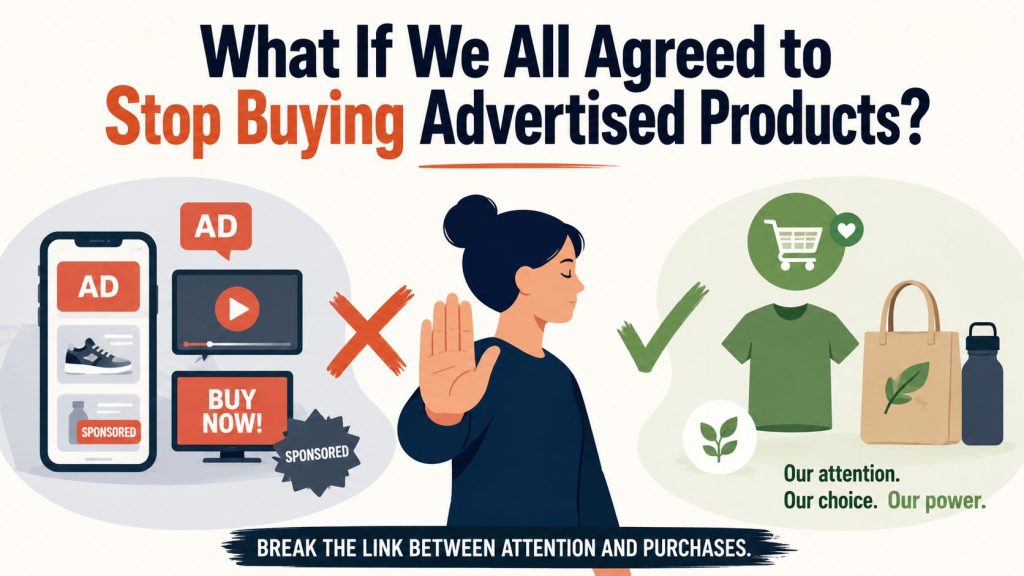
Imagine if we all made one simple decision:
If I see a product advertised to me, I will not buy it.
You see an ad on YouTube for a certain brand? You choose one of the hundred other options.
A creator recommends a candy, a supplement, a clothing brand, a software tool, a drink, a meal kit, a course, or some new gadget? You make a mental note to avoid it.
A product shows up in a movie, a TV show, a podcast, an Instagram reel, a TikTok video, or a sports broadcast?
Same rule.
You don’t buy it.
Not because the product is necessarily bad. Not because the company is evil. But because the entire system depends on the assumption that your attention can be converted into your money.
And if that assumption broke?
The whole thing would start to wobble.
Modern Media Is Built on Selling Access to Our Future Purchases
A lot of modern media isn’t really selling entertainment.
It’s selling access to our future buying behaviour.
The YouTube video, the podcast, the influencer post, the TV show, the sports broadcast, the social media app, the free article, the newsletter, the meme page, the creator economy, much of it is subsidized by one assumption:
Attention can be converted into purchasing.
That’s the deal.
You get the content for free, or cheaper than it should be, and in exchange, advertisers get a chance to shape what you buy later.
But what if the opposite happened?
What if being advertised to made us less likely to buy?
What if exposure became a negative signal?
That would short circuit the attention economy.
The First Thing to Collapse Would Be the Media Funding Model
If everyone stopped buying products they saw advertised, the first thing to collapse wouldn’t necessarily be the products themselves.
It would be the funding model behind media.
Influencer sponsorships would crash. Creators could no longer say, “Pay me because my audience buys what I recommend.”
Ad-supported platforms would panic. Facebook, Instagram, TikTok, YouTube, Google, streaming platforms, online publishers, and podcasts all depend on the belief that targeted attention leads to profitable sales.
Product placement would become radioactive. If people deliberately avoided brands shown in movies or TV shows, companies would stop paying to be there.
Free content would become much harder to fund. More things would move to subscriptions, memberships, paywalls, donations, direct sales, and premium communities.
Creators would have to change their business model. Instead of renting their audience’s attention to brands, they would need to sell something directly valuable to their audience.
In other words, the creator economy would have to become less about influence and more about actual value.
Brands Would Not Stop Marketing. They Would Try to Hide It.
Of course, companies wouldn’t simply give up.
They still need people to know they exist.
A better product doesn’t automatically win if nobody has heard of it. Awareness matters. Distribution matters. Trust matters. Repetition matters.
So if obvious advertising became a liability, marketing would probably become less obvious.
We would see more native content, more PR disguised as journalism, more “organic” recommendations, more affiliate content, more fake grassroots buzz, more brand-owned communities, more subtle product placement, more founder-led content, and more referral programs.
The marketing wouldn’t disappear.
It would move underground.
If people became hostile to obvious ads, companies would get better at disguising persuasion as something else.
The Cost Is Not Just the Price of the Product
A big question is this:
How much of what we pay for products is actually the product, and how much is marketing?
When we buy a candy bar, shoes, makeup, a subscription app, a drink, a vehicle, or a piece of software, part of the price is the cost of making the thing.
But part of the price is also the cost of convincing us to buy it.
That includes ads, sponsorships, influencers, agencies, creative teams, brand campaigns, product placement, affiliate commissions, packaging, retail promotions, and all the machinery required to keep the product in our minds.
So yes, in many cases, marketing is baked into the price.
But the economics aren’t perfectly clean.
If you remove marketing, sales volume might drop. If volume drops, companies lose economies of scale. The factory produces fewer units. Shipping becomes less efficient. Retailers have less incentive to carry the product. The cost per unit can go up.
So there is a paradox.
Marketing can increase prices because it’s a cost. But marketing can also reduce unit costs by creating scale.
Removing marketing wouldn’t automatically make every product cheaper.
But it would change what we’re paying for.
And in a lot of categories, especially fashion, beauty, supplements, beverages, software, lifestyle products, and direct-to-consumer brands, a huge amount of the price is tied to perception, attention, status, and demand creation.
Advertising Does Not Just Tell Us What Exists
The thought experiment gets darker when advertising stops being about information and starts becoming demand creation.
Advertising isn’t only about information.
It’s not just saying, “Here is a product. Here is what it does. Here is where to buy it.”
A lot of advertising is designed to manufacture desire.
It tells us:
You’re not attractive enough.
You’re not successful enough.
You’re not clean enough.
You’re not organized enough.
Your house isn’t nice enough.
Your kids are missing out.
Your business is behind.
Your life needs an upgrade.
So the cost of advertising isn’t only baked into the product price.
It’s baked into the culture.
Advertising changes what people want. It changes what people compare themselves to. It changes what feels normal. It turns ordinary life into a constant state of deficiency.
Products don’t just become more expensive because of marketing. Whole categories of desire get created, normalized, and repeated until they start to feel like needs.
Advertising doesn’t just help us choose between options.
It often convinces us we need the category in the first place.
What Would We Buy Instead?
If everyone became immune to advertising, or even hostile to it, I don’t think people would stop buying things.
We would still buy food, clothes, tools, homes, cars, soap, software, entertainment, services, and everything else we actually need or genuinely enjoy.
But the reason behind our purchases would change.
We would move away from brand-driven consumption and closer to need-driven consumption.
Instead of asking, “What brand have I heard of the most?” we might ask:
What actually works?
What lasts?
What is priced fairly?
What do people I trust use?
What has the best reputation when you strip away the hype?
Would I still want this if I had never seen it advertised?
Companies whose main advantage is attention, image, celebrity, status, and repeated exposure would lose power.
Companies whose advantage is usefulness, durability, service, price, trust, reputation, and word-of-mouth would gain it.
What Would Replace Advertising?
Advertising wouldn’t be replaced by nothing.
It would be replaced by other discovery systems.
Search would become more important because people would look for products when they actually needed them.
Reviews would become more important, though they would also become more manipulated.
Referrals would become more powerful because trust would matter more than exposure.
Independent testing would become more valuable. Consumer reports, expert reviewers, trade forums, comparison databases, Reddit-style discussions, and long-form analysis would all matter more.
Retailers and marketplaces would gain power because if brands can’t create demand through ads, shelf placement and rankings become even more important.
And media would become more directly funded by audiences through subscriptions, memberships, donations, and paid communities.
That might make media less free.
But maybe it would also make it more honest.
Would Society Be Better?
In some ways, I think yes.
There would be less manipulation.
Less junk content designed only to capture attention.
Less fake influencer enthusiasm.
Less status consumption.
Less pressure to constantly upgrade your life.
Less of the quiet psychological tax of being told all day, every day, that you’re incomplete without the next product.
But there would also be tradeoffs.
There would be less free content.
Fewer creators could make a living from sponsorships.
Entertainment might become more expensive.
New companies might have a harder time getting noticed.
Existing incumbents with shelf space, customer habits, retail relationships, and distribution could become even more powerful.
Without advertising, big brands lose one weapon, but challengers may lose one of the few tools that lets them break into the market.
Advertising isn’t only a tool for big brands. It’s also one of the ways challengers get discovered.
So if nobody bought advertised products, we might weaken manipulative consumer culture, but we might also make it harder for unknown companies to reach people.
Maybe the Better Rule Is Not “Never Buy Advertised Products”
The thought experiment becomes more useful when the rule changes from total avoidance to clearer judgment.
Maybe the better rule is not:
Never buy anything advertised.
Maybe the better rule is:
Never buy something because it was advertised.
The jailbreak is refusing the shortcut.
See the ad. Notice the brand. But refuse the emotional shortcut.
Do not let repetition create trust.
Do not let celebrity create credibility.
Do not let production quality create value.
Do not let urgency create need.
Do not let a creator’s enthusiasm bypass your judgment.
Instead, ask:
Is this actually better?
Is it fairly priced?
Do I need it?
Would I buy it if nobody had shown it to me?
Would I still want it tomorrow?
Is this solving a real problem, or did the ad just create a feeling?
If everyone did that, the attention economy might not fully implode.
But it would be forced to become less parasitic.
Brands would have to compete on usefulness, quality, trust, durability, service, and price.
Creators would have to earn attention instead of selling it.
Media would have to provide enough value that people willingly support it.
And consumers would stop acting like passive endpoints in a persuasion machine.
The entire system depends on us being influenceable.
If we collectively decided to become harder to influence, not impossible to inform, not impossible to persuade, but harder to manipulate, a lot of modern media, advertising, and consumer culture would have to change.
And honestly, maybe that wouldn’t be such a bad thing.